Overview
Overview
Investment banking is one of the most competitive career paths in finance. The combination of challenging work, exposure to major transactions and strong compensation makes it attractive to a lot of students and early career professionals.
But actually breaking into banking is a different story. The recruiting process is highly-competitive, and it can be especially difficult if you're coming from a non-target school, switching careers or trying to figure out the process without knowing anyone in the industry.
The good news is that there is a fairly clear playbook. Whether you're an undergraduate, someone already working in finance, or an MBA candidate, understanding where to apply, how to build your resume, how to network and how to prepare for interviews can make a big difference.

TL;DR
- Figure out whether the analyst or the associate path makes the most sense based on your education and work experience.
- Use internships, case competitions, strong academics and other relevant experiences to show that you're serious about banking.
- Build genuine relationships with bankers and alumni, rather than relying on applications alone.
- Prepare your personal story and get comfortable with the accounting, valuation, and corporate finance concepts that frequently come up in interviews.
- Good preparation matters, but so does staying calm and communicating clearly when you're under pressure.
1. Identify Your Ideal Entry Point
Before you start applying to banks, you need to figure out which role you're actually recruiting for. The two main entry points are the Analyst and the Associate positions. The right one depends largely on where you are in terms of your education and career.
The Analyst Path
For most college students, the analyst role is the conventional way into investment banking. Banks recruit heavily from undergraduate programs for their analyst classes, particularly for summer analyst internships between junior and senior year. Students at schools with established banking recruiting pipelines often have access to structured recruiting, but that doesn't mean the process is easy. You're still competing against a large pool of strong candidates.
And the timeline runs much earlier than most students realize.
Recruitment Timeline
- Sophomore Winter/Spring - Banks typically start interviewing for junior-year summer analyst internships. For some banks, the process can begin even earlier.
- Junior Fall - By the beginning of junior year, many summer analyst offers have already been made.
- Junior Summer - Your summer internship is your biggest opportunity to earn a full-time offer. Perform well and you may receive an offer to return after graduation.
- Senior Fall - The remaining full-time positions generally open around August or September. By this point, there are often far fewer spots available, which makes the process even more competitive.
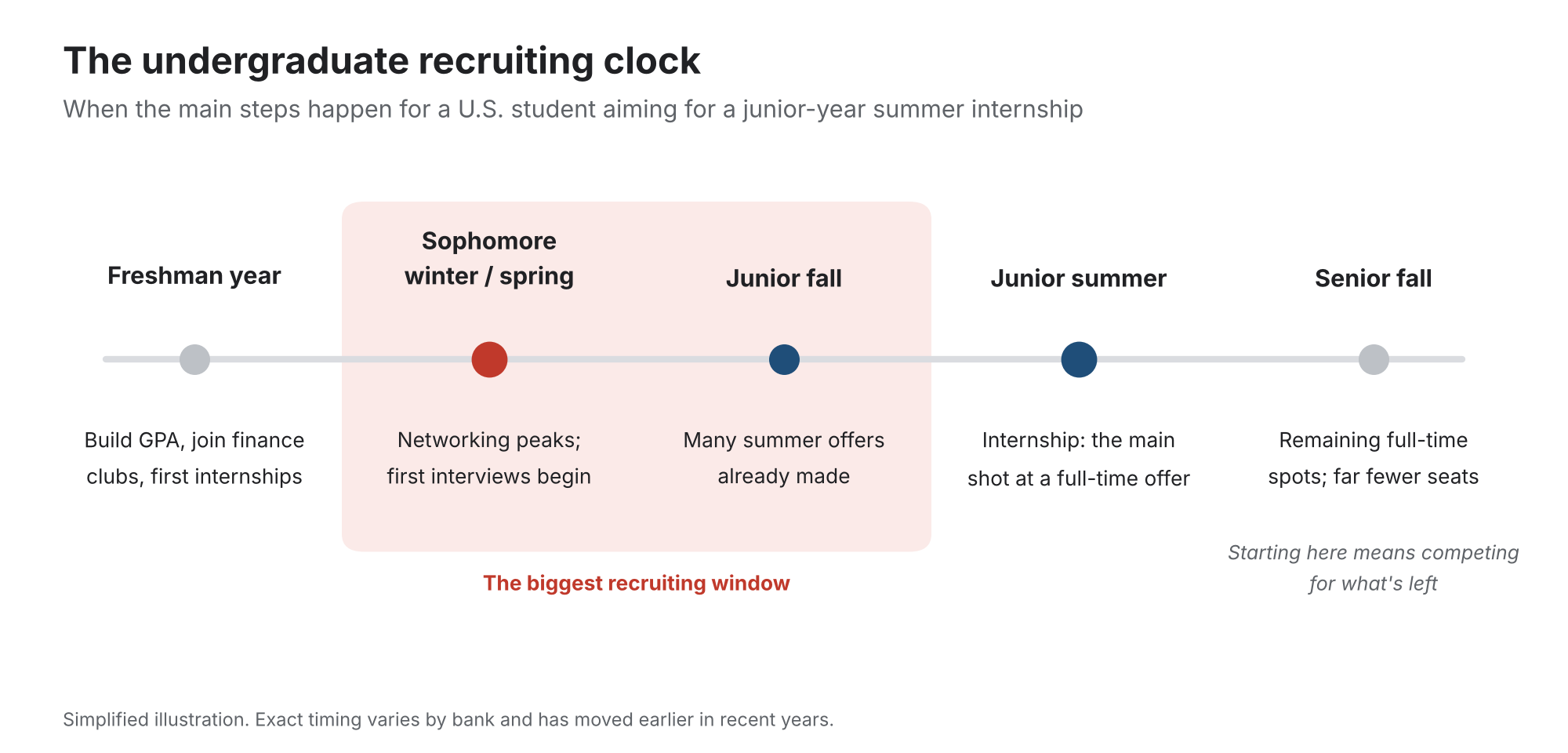
This is why starting early matters so much. If you wait until senior year to start networking and applying, you may have missed the biggest recruiting window.
If you've already graduated and are one to two years out of college, getting into banking as an analyst becomes more difficult. That doesn't mean it's impossible, but you'll usually need to find a less traditional route. There are a few options:
- Master’s in Finance (or a similar degree) - Some programs have strong recruiting pipelines into major banks and can give you another opportunity to recruit as a student.
- Internal Transfer - If you're already working at a bank in another division, moving internally into investment banking can sometimes be easier than trying to break in from the outside.
These routes are less common than traditional undergraduate recruiting. If neither is realistic for a particular case, the Associate Path may make more sense.
The Associate Path
For professionals who are further along in their careers, the typical route into investment banking is through an MBA.
Banks recruit heavily from leading MBA programs, particularly the top 10-15 schools. A broader group of top MBA programs can also provide access to investment banking recruiting. Getting into a top MBA program generally requires a solid academic record, meaningful work experience and a competitive GMAT score.
Once you're in an MBA program, the recruiting process looks somewhat similar to undergraduate recruiting. You have to network with bankers, attend recruiting events, interview with different firms and potentially complete an internship before receiving a full-time offer. The main difference is that your previous work experience becomes a much bigger part of your story.
If you're in your mid-30s or beyond without previous investment banking or transactional finance experience, breaking into the industry becomes significantly harder. Banks are generally reluctant to hire experienced professionals into junior roles if they don't have a relevant background.

2. Get Your Resume Ready
Your resume has one job during recruiting which is to get you the interview.
Especially at the analyst level, banks receive a huge number of applications, so recruiters need to quickly understand whether you have the academic background and experience they're looking for.
Gain Relevant Experience Early
If you're still in college, internships are one of the best ways to show that you're serious about finance.
Investment banking internships are obviously the most directly relevant, but don't underestimate boutiques, private equity firms, asset management, equity research or finance roles at larger companies.
Previous finance experience also gives you something concrete to talk about. You can point to actual work you've done, whether that's financial modeling, company research, valuation, or analyzing a business, instead of simply saying you're interested in banking.
If you're an undergrad, don't limit yourself to one summer internship. Look for opportunities during the semester, winter break or whenever you have time. Even a small amount of relevant experience can give you an edge during networking and in interviews.
Participate in Case Competitions & Conferences
Case competitions and conferences can also help strengthen your resume, particularly when you don't have much finance experience. Case competitions give you a chance to analyze a company or a business problem, work with a team, develop a recommendation and present your thinking. Bank-sponsored conferences and early-career programs can also give you exposure to the industry while putting you in a room with bankers.
Aim for a Strong GPA
Your GPA matters, especially when you're recruiting straight out of college. Many banks use GPA cutoffs when screening applications, and a GPA around 3.3 is a common benchmark in banking recruiting. A 3.5+ puts you in a stronger position, while a 3.7+ can make the academic portion of your resume very attractive.
Your GPA isn't going to get you an offer on its own. But if it's strong, it's one less thing a recruiter has to question.
Perfect Your Formatting and Tailor Content
Bankers and recruiters don't have time to read through a resume that's difficult to follow. Keep it concise, make the important information easy to find and focus on things that are actually relevant to the role.
Highlight finance internships, quantitative work, financial modeling and relevant coursework. Use clear action verbs like “analyzed,” “modeled,” “researched,” and “evaluated” so it's obvious what you actually did.
For most undergraduate candidates, one page is enough. Small errors matter more than you think. If you're applying for a job where attention to detail is non-negotiable, you don't want your resume to contain typos.
3. Networking Is Critical
If there's one part of banking recruiting that candidates consistently underestimate, it's networking. You can have a great resume, but that doesn't mean your application will automatically make it to the top of the pile.
Banking is a relationship-driven business. Bankers spend long hours working with the same people, often 80-100 hours a week. They want to work with people they like, trust and believe they can rely on. That's one reason networking matters so much.
A good conversation with a banker can help you get an interview or put you on the radar of someone involved in recruiting. More importantly, it gives the banker a reason to remember you when candidates are being discussed internally.
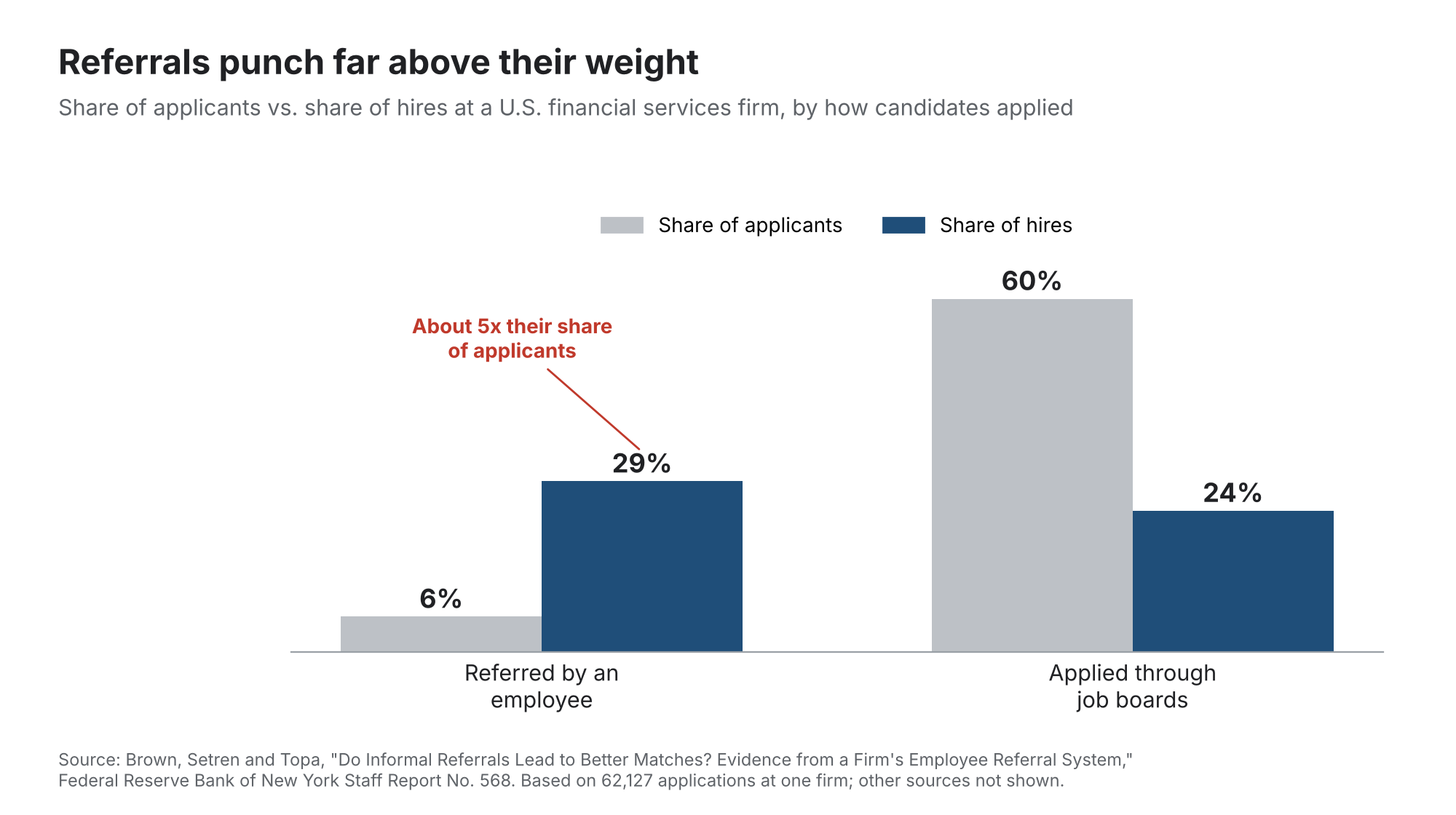
Don't think of networking as sending as many cold emails as possible. The goal isn't to collect the most conversations. It's to have a few conversations through which the person actually remembers you.
Networking also helps you understand when recruiting is happening. Recruiting timelines can move quickly and different banks don't always follow exactly the same schedule. By building relationships with bankers ahead of time, you have a much better chance of hearing about recruiting opportunities while there are still plenty of spots available.
This is particularly important because recruiting can start much earlier than students expect.
Networking doesn’t mean collecting thousands of LinkedIn connections, the best conversations are usually the ones where you've actually taken the time to learn something about the person you're speaking with. Alumni are often a good place to start because you already have something in common, but the conversation shouldn't just be a list of questions about banking. Ask about their career, their experience and what they actually enjoy about the job.
And follow up thoughtfully. If you spoke about something specific, reference it instead of sending generic thank you notes.
Most importantly, personalize your outreach. The messages that stand out are the ones where the sender has clearly spent time researching the person on the other side.
That's the difference between networking as a numbers game and actually building relationships.
4. Prepare for Interviews
Once your resume is strong and your networking efforts start generating interviews, you need to be ready for the next step.
Most investment banking interviews will test you in two broad areas, behavioral and technical questions.
Behavioral Interviews
Behavioral questions are designed to understand who you are, why you're interested in banking and how you handle different situations.
You should have a clear answer for questions like “Tell me about yourself,” “Why investment banking?” and “Why this bank?” You should also have a few good examples that show how you've worked with other people, handled difficult situations and taken ownership of something.
Your story should make sense across your resume, networking conversations and interviews. You don't want to sound like you're pulling a completely different answer out of a script every time someone asks why you want to be a banker.
One of the best ways to make your story stronger is to start with something personal. Maybe you started investing in college, took a financial modeling course, worked on a business project or had a conversation with someone in banking that changed your perspective.
It doesn't have to be an incredible story, it just has to be your story.
Technical Interviews
Technical questions test whether you understand the fundamentals of finance.
You should be comfortable with accounting, valuation, DCFs, LBOs, and corporate finance. That includes understanding how the three financial statements connect, the difference between equity value and enterprise value, and the basics of comparable companies, precedent transactions, and DCF analysis.
Don't just memorize technical interview guides. Practicing building real models is how you can learn valuation, deal structures and how financial statements work together, which will help you answer almost every technical question in the interview.

5. Excel During the Interview Process
With your resume, networking, and interview preparation in place, the final step is being able to perform when the actual interviews begin.
Overview of the Process
While every bank runs recruiting slightly differently, the process generally has two main stages. First rounds are often phone, Zoom or digital interviews where you'll answer a mix of behavioral and technical questions. If you make it through, you'll typically move on to a Superday, where you meet with several bankers across different levels of the firm.
The exact format can vary, but the principle is the same, you need to be prepared for anything.
Preparation
Two things matter most here, preparation and how you handle pressure.
You should be comfortable with the common behavioral questions and the technical concepts you're likely to be tested on. But you also won't know the answer to every question. If you get stuck, don't panic or start guessing. Explain what you do know, walk through your thought process and ask a clarifying question if you need to.
And remember, interviewing is a skill.
You get better through repetition. Practice your answers out loud, record yourself and build enough stories that you can adapt them to different questions instead of memorizing one script.
Finally, don't try to sound like the perfect investment banking candidate. Interviewers can usually tell when someone has memorized a script. Don't throw around jargon you don’t understand just because it sounds impressive. If you use a term, make sure you can actually explain what it means.
You should also come prepared with questions about the bank, its deals, the team or the interviewer's own experience. The best questions are usually the ones you genuinely want the answer to.
You don't need to know everything. You just need to show that you're prepared, interested, thoughtful and someone people would actually want to work with.
The Bottom Line
Breaking into investment banking takes more than a strong GPA and a polished resume.
You need to understand the recruiting timeline, build relevant experience, network consistently and prepare enough that you can handle both behavioral and technical interviews without sounding rehearsed.
Don't underestimate how much work the process actually takes. The strongest candidates aren't necessarily the ones who had everything handed to them. They're the ones who started early, did their research, reached out to bankers, practiced their interviews and kept getting better throughout the process. Starting early and building strong relationships will give you the best chance of breaking in and getting that banking offer.