Overview
Overview
If you are trying to break into investment banking, it seems easy and obvious to focus on the name of the bank.
Goldman Sachs, Morgan Stanley, J.P. Morgan, Evercore and the other big names all have strong reputations. But the bank you work at is only one part of the story. The group you join can have just as much impact on your experience.
A strong technology group at one bank can give you better deal experience than a weaker group at a more prestigious bank. The same is true for healthcare, restructuring, financial sponsors and other areas.
That is why it is worth looking beyond the overall rankings. Deal flow, the people you work with, the type of transactions you get to work on and where analysts go after banking can tell you much more about what the job will actually be like.
TL;DR
- The best banks are not necessarily the best in every industry. Some have particularly strong teams in areas like TMT, healthcare or restructuring.
- The group can matter more than the bank. Your deal experience and exit opportunities will depend heavily on the team you join.
- Culture varies a lot across banks and even across groups within the same bank.
- Elite boutiques can compete with the biggest banks by offering smaller teams, strong deal flow and more responsibility.
- Before choosing a bank, look at the group, the deals, the people and where recent analysts have gone.
1. Why the Group You Join Matters
Getting into a good investment bank is only the first step. You also need to think about which group you are joining.
Your group determines the type of work you will actually do. A technology team might spend its time working on IPOs and large tech M&A deals, while a healthcare team could be focused on acquisitions, partnerships and other transactions in the sector.
The same bank can have a great group in one area and a much weaker group in another. Some banks also have separate M&A teams, while others have M&A bankers sitting within industry coverage groups.
This matters because deal experience is one of the most valuable things you get from banking. Working on large, complicated transactions with strong senior bankers can make you better at the job and can also help when you start looking at exit opportunities.
A strong group can also make recruiting easier. Analysts coming from teams with good deal flow and recognizable clients tend to have an easier time getting the attention of private equity firms, hedge funds and corporate recruiters.
Location can matter too. A West Coast office may be particularly strong in technology, while an LA team might have more exposure to media and entertainment.

2. Banks With Strong Industry Groups
Different banks are known for different areas. If you already know which industry you want to work in, this is one of the first things you should look at.
Bank of America is known for financial sponsors, M&A and leveraged finance. Its Real Estate, Gaming & Lodging group is also well regarded.
Centerview has a more generalist model in many offices, with strong deal flow across areas such as healthcare, consumer and technology.
Evercore also starts many analysts on a generalist basis before placing them into groups. It has strong teams across media, technology and telecom, while some offices have a bigger focus on areas such as oil and gas.
Goldman Sachs is particularly strong in TMT and financial institutions. Its industry teams also have significant M&A experience.
J.P. Morgan has strong M&A and healthcare businesses, along with meaningful deal flow in TMT and financial sponsors.
Lazard is particularly well known for restructuring and also has strong healthcare and consumer teams.
Moelis has a strong media team in Los Angeles, along with restructuring and sponsors teams in New York.
Morgan Stanley has a strong M&A business and is well known for its media, technology and telecom coverage in both New York and Menlo Park.
Perella Weinberg has a focus on healthcare and restructuring, along with media and telecom.
PJT Partners is particularly strong in restructuring and also has a respected M&A business.
One other difference is the balance sheet. Banks such as Bank of America and J.P. Morgan can use their financing capabilities to support clients alongside their advisory work. That can help them win large mandates.
Boutiques have a different advantage. Because teams are smaller, they can attract people who want more direct exposure to senior bankers and clients.
If you already know the sector you want to work in, look at the actual deal flow of that group before applying. A great bank name does not help much if the office or group you join is not doing the type of work you want.

3. Finance Career or a Better Lifestyle?
There is no single answer to what makes a good banking job.
Some people are willing to work very long hours if it means getting better deal experience and stronger exit opportunities. Others care more about having good mentors, a reasonable culture and some control over their time.
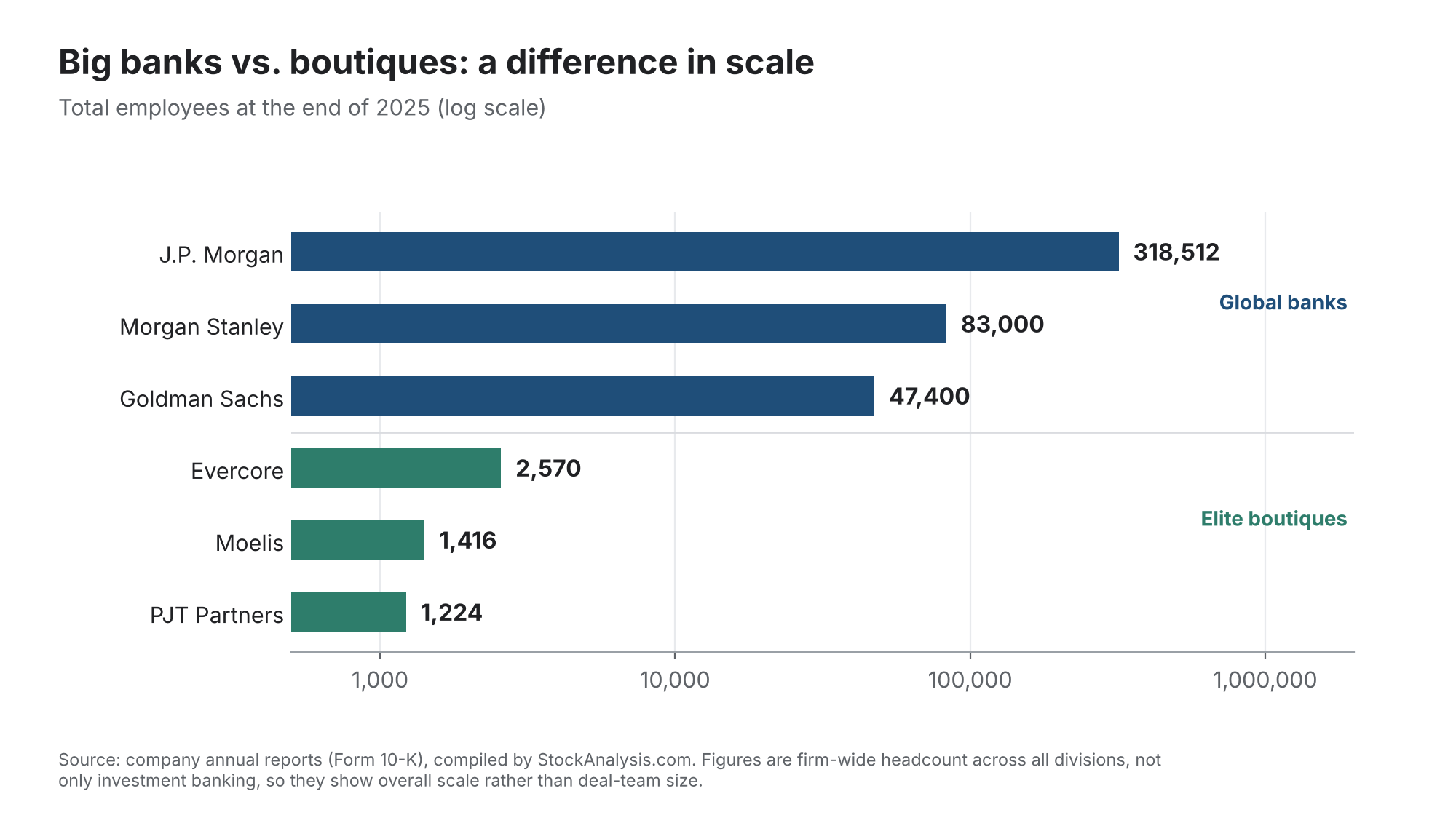
Large banks often have more structured training and bigger teams. That can be useful when you are starting out because there are more people around you who can mentor you. The downside is that you can sometimes feel like a small part of a very large organization.
Boutiques tend to have smaller teams, so analysts can get closer to the deal and senior bankers. That can be great for learning, but it can also mean more work when the team is busy because there are fewer people to share it with.
The bank's reputation outside finance can also matter. If you think you might eventually move into technology, consulting or corporate strategy, a large global bank may carry more recognition with people who do not work in finance.
4. A Finance-Focused Ranking
If your main goal is to build a career in finance and eventually move into private equity, hedge funds or other competitive finance roles, the following ranking is one way to think about the major players.
- Goldman Sachs - Strong global brand, excellent TMT and FIG teams, and broad exit opportunities.
- Morgan Stanley - Strong M&A franchise and particularly good exposure to TMT.
- PJT Partners - Excellent restructuring business, strong M&A and smaller teams.
- Evercore - Strong boutique brand, high compensation and good coverage across media, technology and telecom.
- J.P. Morgan - Large balance sheet, strong healthcare and M&A teams, and a global platform.
- Moelis - Strong media and sponsors businesses and good exits, although the hours can be demanding.
- Centerview - Strong compensation and a strong client base, with some restrictions around early buy-side recruiting.
- Lazard - Excellent restructuring reputation and strong exits, although the firm is now larger than it used to be.
- Perella Weinberg - Strong healthcare and restructuring businesses, with a newer brand than some of the firms above it.
- Bank of America - Strong sponsors and M&A teams and one of the better options among the larger second-tier banks.
But do not treat this as a universal ranking. The right order can change depending on what you want to do. A bank that is number ten overall could be number one for a specific industry or office. Compensation is also fairly competitive at the top, while smaller firms can sometimes give you more direct exposure to senior bankers and transactions.
5. Ranking Banks by Culture
The ranking changes if you care more about culture, training and long-term flexibility than getting the biggest possible finance exit.
Large banks can be attractive because they have bigger alumni networks and more opportunities outside traditional finance. If you eventually want to move into technology, consulting or start a company, having a recognizable global brand on your resume can help.
They also tend to have more structured training. For someone coming straight out of college, that can make the first year easier because there is usually a clear process for learning the job.
Boutiques can offer a different experience. Smaller teams often mean more responsibility and closer relationships with senior bankers. You may see more of a deal from beginning to end, rather than working on one small part of it.
The tradeoff is that a smaller team can also mean more work when deal flow picks up. You may get more responsibility because there are simply fewer people around to do the work.
Culture also matters more than people sometimes realize. Having a good manager who teaches you and gives you useful feedback can make a much bigger difference than having a slightly better name on your profile.
6. Niche Banks and Special Cases
Some banks do not fit neatly into a traditional ranking because they are extremely strong in one specific area.
Qatalyst is a good example. It focuses almost entirely on large technology M&A and has built a strong reputation in that market. Allen & Co. is another example, with a strong position in media and entertainment and a reputation for keeping a low profile.
These firms may not have the same name recognition as Goldman Sachs or J.P. Morgan outside finance, but that does not mean they are less respected within their industries.
The same idea applies to smaller firms that specialize in areas such as real estate, healthcare or biotech. If a boutique has strong relationships with the best companies in a particular sector, working there can give you better exposure to that industry than joining a much larger bank where the sector is not a major focus.
If you already know the industry you want to work in, do not ignore smaller firms. A boutique that dominates one niche can sometimes be a better place to build expertise than a large bank with a broader but weaker presence in that area.
7. Choosing the Right Fit
There is no single bank that is best for everyone.
Start with the type of work you want to do. If you are interested in technology, healthcare, restructuring or financial sponsors, find out which banks actually have strong teams in those areas.
Then look at the specific office and group. Deal flow can be very different between offices, even within the same bank. A strong New York group may have very different opportunities from a smaller office at the same firm.
Team size matters too. Larger teams can give you more support and structured training, while smaller teams can give you more responsibility earlier.
And then there is culture. This is difficult to understand from a website or a ranking, which is why talking to current analysts is so useful. Ask them what their day actually looks like, how much junior bankers interact with senior people, what kind of deals they have worked on and where people from the group have gone afterward.
Look at the alumni as well. If most analysts from a particular group move into the exact career you want, that tells you something that a generic ranking cannot.
The Bottom Line
The best investment bank is not necessarily the one with the best overall ranking.
A strong brand can help you get interviews and open doors, but your actual experience will depend much more on the group you join. The deals you work on, the people you learn from and the responsibility you get will shape how much you take away from your first few years.
Goldman Sachs, Morgan Stanley and J.P. Morgan have some of the strongest platforms in the industry. Boutiques like Evercore, Moelis and PJT can offer smaller teams and more specialized experience. Other banks may not rank as highly overall but can be excellent choices if they have a strong group in the industry you care about.