Overview
Overview
Investment banking and management consulting are two of the most common paths for people who want a strong start in their career and a steep learning curve.
Both can lead to high-paying careers, give you exposure to senior executives, and open doors to other opportunities later. But the actual work is very different.
In investment banking, the focus is largely on transactions, financial analysis, and getting deals done. In consulting, the work is more focused on helping companies solve business problems and make strategic decisions.
Neither is inherently better than the other.
The better choice depends on what kind of work you enjoy, how you want to spend your time, and where you want the experience to take you.
TL;DR
- The company matters - The quality of the company, team, and people you work with can have a big impact on your experience and future opportunities.
- The work is different - Banking is more focused on transactions, financial modeling, and deals. Consulting is more focused on strategy, problem-solving, and business decisions.
- Both have strong exit opportunities - Banking can lead to private equity, hedge funds, corporate development, and other finance roles. Consulting can lead the path to strategy, operations, technology, and general management roles.
- The lifestyle is very different - Banking tends to have longer and less predictable hours, while consulting usually involves more travel and project-based work.
- The right choice depends on the person - If you enjoy finance and don't mind intense hours, banking may be a better fit. If you prefer broader business problems and more variety, consulting may make more sense for you.
1. Understanding the Firm Hierarchy
Where you work matters in both investment banking and consulting.
The company you join can affect the clients you work with, the projects you get, your compensation and the opportunities available to you later.
Investment Banking
Investment banks are often grouped into different tiers based on their size, reputation and deal flow.
At the top are the global bulge-bracket banks such as Goldman Sachs, Morgan Stanley, and J.P. Morgan. They have large platforms and work on some of the biggest transactions in the market.
Then there are elite boutiques such as Evercore, Centerview and Qatalyst. These firms are much smaller, but they are extremely well respected within finance and can offer very strong deal experience.
Below them are other large banks, smaller boutiques, and middle-market firms. These can still provide excellent experience, but the size and type of transactions can be different.
The important thing is that the name of the firm isn't everything. It’s the group, the people you work with, and the type of deals you're staffed that have a huge impact on your actual experience.
Management Consulting
Consulting has a similar structure.
At the top are McKinsey, Bain, and Boston Consulting Group, commonly referred to as MBB. These firms are known for high-level strategy work and work with many of the world's largest companies.
There are also firms such as Oliver Wyman, L.E.K., and Booz Allen Hamilton, along with strategy arms of the Big Four - PWC, KPMG, EY and Deloitte. Beyond that are larger implementation-focused firms and smaller specialist consultancies.
The same rule applies here, the firm name matters, but so does the team you're actually joining.
A great manager and a good team can make a big difference in how much you learn and how much you enjoy the job.

2. What the Work Actually Looks Like
This is probably the biggest difference between the two careers.
Life in Investment Banking
Investment banking is centered around transactions.
That could mean helping a company acquire another business, advising a company that is being sold, or helping a company raise debt or equity.
A junior banker might spend the day building or updating a financial model, researching a company, preparing a pitch deck, or making changes to materials based on feedback from senior bankers or clients.
You may also work on multiple deals at the same time. One could be at the early pitch stage while another is already deep into due diligence.
The work is fast and detail-heavy, and deadlines can change quickly.
Life in Management Consulting
Consulting is more focused on solving business problems.
A project might involve helping a company enter a new market, improve its operations, launch a product, or figure out why a particular part of the business isn't performing.
Instead of spending most of your time in Excel and financial models, you may spend more time gathering information, analyzing data, speaking with people inside the company, and turning that information into a recommendation.
Consulting also tends to be more project-based. You might spend several weeks or months working closely with one client before moving on to something completely different.
That variety can be a major attraction for people who don't want to spend their entire career focused on transactions.
3. Why Choose Investment Banking?
There are some pretty good reasons people choose banking, especially early in their careers.
One such reason is the exposure. Bankers work with companies during some of their most important moments, whether that's an acquisition, a sale, or a capital raise. Even junior bankers can get a look at how CEOs and CFOs think about major decisions.
Then there are the technical skills. Financial modeling, valuation, and understanding how transactions actually work are useful skills that can stay with you long after you leave banking. The experience also teaches you how to get a lot of work done under tight deadlines.
And banking gives you a lot of options later. After a few years, some bankers move into private equity, hedge funds, corporate development, venture capital, or other finance and business roles. That's one reason banking can be such a useful first job if you aren't completely sure where you want to end up.
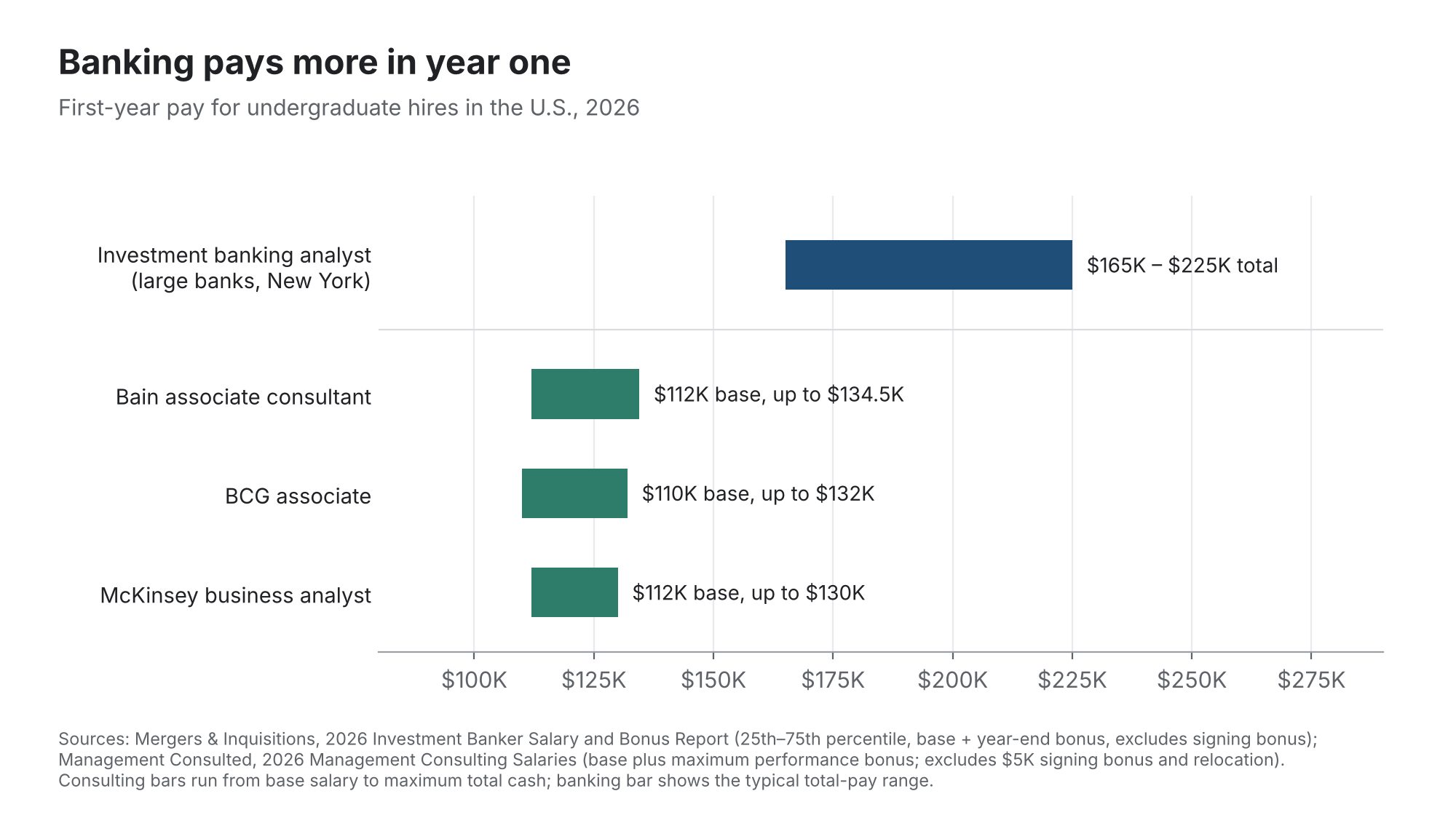
The compensation is another obvious advantage. Banking can pay very well early in a career, although bonuses can change significantly depending on deal activity and the broader market.
The trade-off is that you are giving up a lot of your time and flexibility for those opportunities.
4. Why Choose Management Consulting?
Consulting offers a different set of advantages. The biggest one is probably the variety of problems you get to work on.
You might work on a market-entry project for one client and then spend the next few months helping another company improve its operations. You get exposure to different industries, businesses, and types of problems without having to stay focused on one type of transaction.
The work also tends to be broader. Instead of asking, "What is this company worth?" the question might be, "Should this company enter this market?" or "How can it grow this part of the business?"
That can be a great fit for someone who enjoys strategy and solving open-ended problems.
The lifestyle can also be different from banking. Consulting can still involve long hours, but working weekends are generally less common. Travel, however, can be a bigger part of the job, with some consultants spending Monday through Thursday at a client site.
And like banking, consulting can lead to a wide range of careers later. Consultants can move into corporate strategy, operations, technology, startups, and other business roles.
5. The Downsides of Both Careers
Neither choice is perfect.
The Cons of Investment Banking
The biggest issue is the hours. A 70-100 hour week isn't unusual, and during a busy deal, things can get even more intense. You're also often expected to respond quickly when something comes up, even outside normal working hours.
The work can also become repetitive.
Different transactions have different details, but the basic processes can start to look familiar after you've done them enough times. This is one reason some bankers eventually look for roles where they can take on different types of work.
And unlike consulting, banking generally doesn't come with the same level of travel or other lifestyle perks.
The Cons of Management Consulting
Consulting has its own trade-offs. Travel can be exhausting. Flying out at the beginning of the week and coming home at the end can make it difficult to maintain a normal routine.
There is also a certain distance between the recommendation and the actual result.
A consulting team can spend months helping a company decide what it should do, but the client still has to execute the plan. For someone who wants to be directly involved in the outcome, that can be redundant.
And the project-based structure means you're constantly adjusting to new teams, clients, and working styles. For some people, that's the best part of consulting and for others, it gets tiring.

6. How to Decide Between the Two
There isn't a single right answer here. Start with the kind of work you actually want to do.
If financial statements, valuation, Excel, and transactions sound interesting, investment banking may be the better fit.
If you're more interested in broad business problems, strategy, and figuring out why something isn't working, consulting may be more appealing.
Then think about lifestyle.
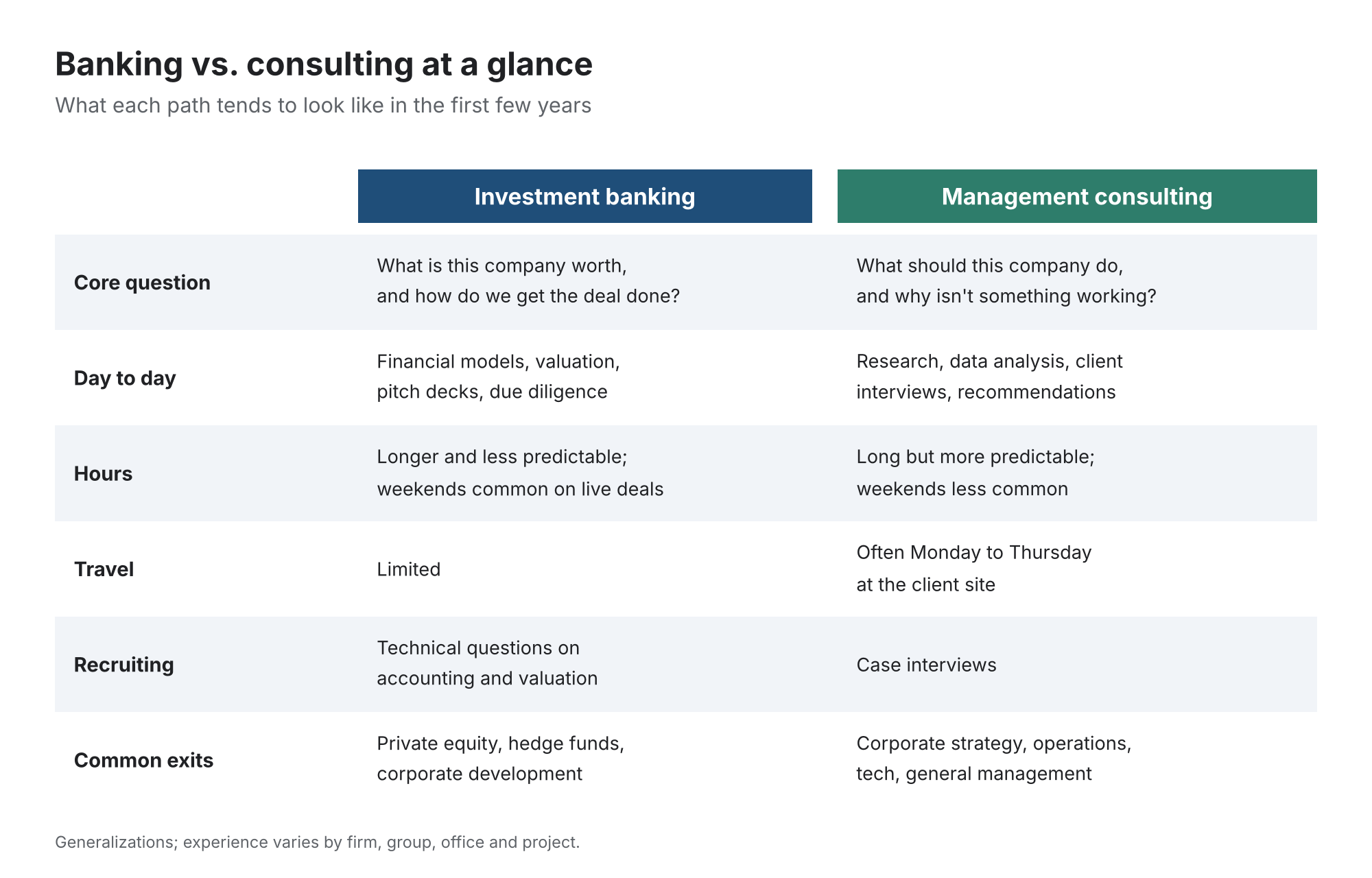
Banking generally means longer and less predictable hours. Consulting can offer a bit more predictability, but travel can become a major part of your life.
It's also worth thinking about where you want the experience to take you.
Banking is a strong starting point for careers in private equity, hedge funds, corporate development, and other finance-heavy roles. Consulting can be a strong path into corporate strategy, operations, technology, and general management.
And don't ignore the recruiting process.
Banking interviews place a lot of emphasis on technical knowledge, financial concepts, and whether you can demonstrate that you've actually put in the work. Consulting recruiting is different, with case interviews playing a much bigger role.
Ultimately, the question isn't which career looks better on paper.
It's what type of work you can see yourself doing for the next few years.
The Bottom Line
Investment banking and consulting are both strong ways to start a career, but they train you in different ways.
Banking gives you deep exposure to transactions, financial modeling, valuation, and the mechanics of how companies raise capital and buy or sell businesses. It can also open doors to a wide range of finance roles later.
Consulting gives you broader exposure to business problems. You can work across different industries and projects, build strategic and problem-solving skills, and eventually move into a wide range of business roles.
The trade-offs are different too.
Banking gives you deeper financial experience, but the hours are tougher. Consulting gives you broader business exposure, but travel and constantly changing projects can become tiring.
Neither is automatically the better career.
The best choice is the one that matches the kind of work you actually enjoy, the lifestyle you're willing to accept, and where you want the experience to take you.
If you're still unsure, that's okay. You don't need to have your entire career figured out at 21 or 22. The important thing is to understand what each path actually looks like before choosing one.