Overview
Overview
There is no such thing as a typical week in investment banking.
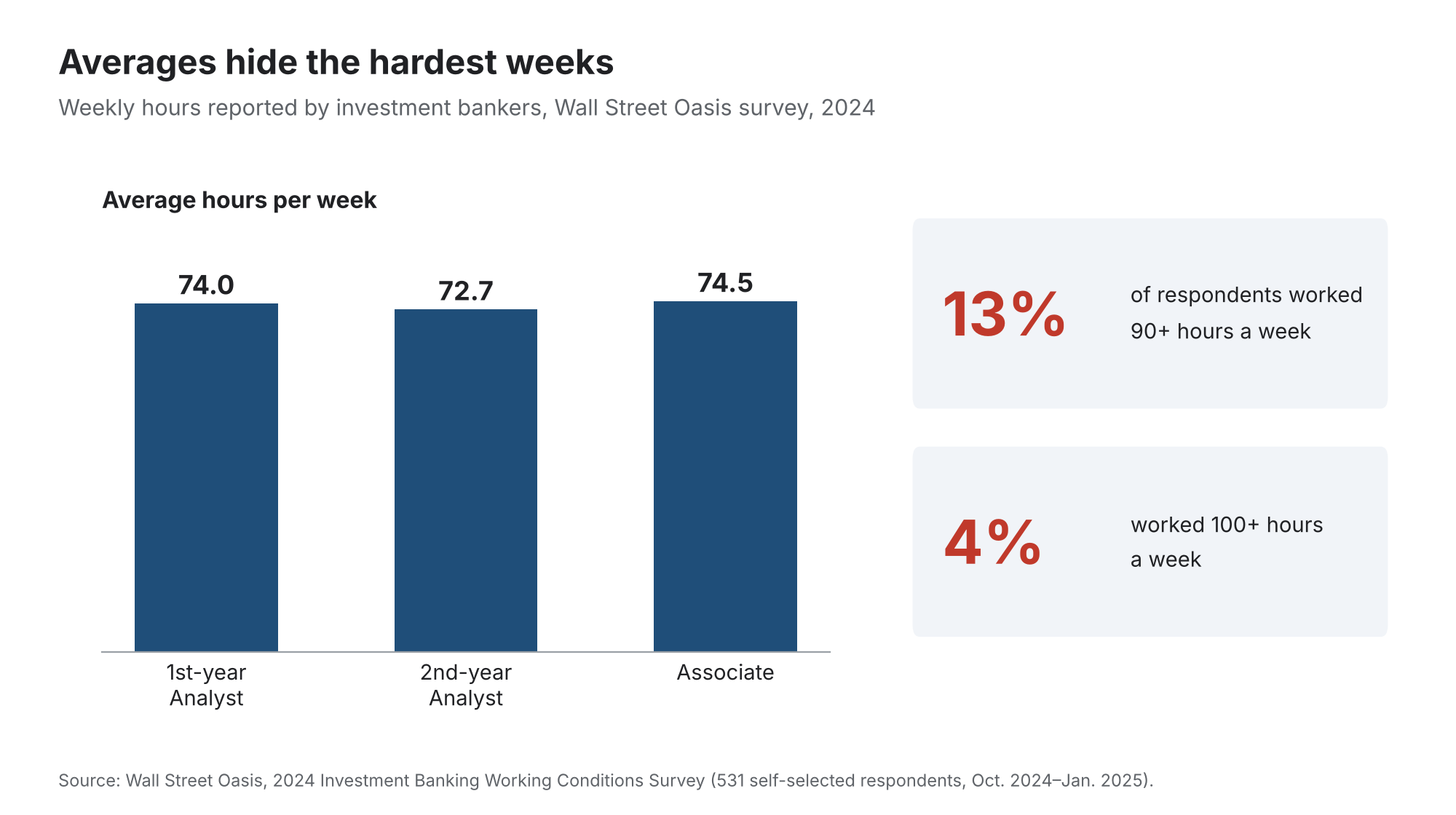
Some weeks are relatively manageable. A banker might work around 60 hours, leave the office at a reasonable time on some days, and even have part of the weekend free. Other weeks can look completely different, with late nights every day and work continuing through Saturday or Sunday.
The biggest difference usually comes down to what the team is working on. A quiet pitchbook is very different from an active M&A deal with a client deadline the next morning.
Understanding that difference is important if you are considering a career in banking. It also helps if you work with bankers as a client, founder, or business partner. Knowing when their workload is likely to increase can make it easier to plan meetings, deadlines, and requests.
TL;DR
- Hours can change quickly - A manageable week might be around 60 hours, while a difficult week can go well over 100.
- The type of work matters - Live M&A deals usually require much more time than routine pitchbook work.
- Weekends are not always protected - Some banks have protected weekend policies, but important deals can override them.
- Prioritization matters - When several things are happening at once, knowing what needs to be done first is critical.
- Recovery matters too - Using quieter periods to rest can make the more intense weeks easier to handle.
1. Why Easy and Hard Weeks Matter
Investment banking hours can seem unpredictable, but there are usually clear reasons for the changes.
A banker working on a pitch with no immediate deadline may have a relatively normal week. The same banker could be working until 2 a.m. a few weeks later if a client is in the middle of an acquisition.
For people working with investment banks, understanding this difference can be useful. If you know a banker is in the middle of a live transaction, you can expect slower responses and less flexibility.
It can also help you plan your own work. If you need detailed analysis, due diligence, or a valuation from a banking team, giving them more time during a busy deal can make the process much smoother.
The key is to understand what is driving the workload rather than assuming every week will look the same.
2. What an “Easy” Week Looks Like
An easy week in investment banking does not mean a nine-to-five schedule.
Even when things are relatively quiet, an analyst might still work around 60 hours. The difference is that the work is more predictable and there are fewer urgent requests.
A calmer week is more likely when deals are either just starting or close to being finished. Pitchbook work can also be more manageable because the team often has more time before the client meeting.
During a week like this, a banker might start around 9:00 or 9:30 a.m. and finish around 8:00 p.m. A Friday could even end earlier if the team has a protected weekend.
Even an easy week can include a few late nights. The point is not that the work becomes easy. It is that the workload is more predictable and there is less constant urgency.
3. What a Hard Week Looks Like
A hard week is what most people imagine when they hear about investment banking.
You might finish at 1 or 2 a.m. several nights in a row, only to start again the next morning. If a deal is active over the weekend, you may also need to work on Saturday or Sunday.
What Usually Causes a Hard Week?
Active M&A deals are one of the biggest reasons. There may be tight deadlines, negotiations, new information from the client, and multiple teams waiting for updated materials.
Multiple live projects can make things even harder. If an analyst or associate is working on two important transactions at the same time, priorities can change throughout the day.
Client and senior banker requests are another major factor. A new revenue forecast, a change to a presentation, or a request for another analysis can add hours of work with very little warning.
During these periods, midnight finishes can become routine. Friday can turn into Saturday morning, and weekend work may be needed to get a model or presentation ready for Monday.
These periods are exhausting, but they can also be where analysts learn the most. Working through a difficult transaction forces people to become faster at modeling, more careful with details, and better at communicating under pressure.
4. Pitchbooks vs. Live Deals
One of the easiest ways to understand the difference between an easy and hard week is to look at the two types of work bankers commonly handle.
Marketing Pitchbooks
A pitchbook is usually created when a bank is trying to win a new piece of business.
The team might analyze an industry, look at potential strategic options, build valuation materials, and prepare a presentation for a potential client.
There can still be tight deadlines, especially if a client meeting is coming up. But the work is generally more predictable because the bank is not yet executing an actual transaction.
Live Deals
A live deal is different. The bank has already been hired and is actively working on a transaction.
This could be an M&A deal, an equity transaction, or a debt offering. The team may need to update financial models, prepare presentations, answer questions from the client, and coordinate with lawyers and other advisers.
The biggest difference is the urgency. When something changes on a live deal, the team usually cannot wait until next week to deal with it.
Pitchbooks can certainly become demanding, but live deals are usually where the hours become much harder to control.
5. How Bankers Manage the Busy Periods
Working long hours is difficult enough. Doing it while juggling several projects at once makes things even harder. A few habits can make a difference.
1. Prioritize the Most Important Work
Not every task has the same deadline or consequence.
Start with the work that is most time-sensitive, particularly anything related to a live deal or an important client meeting. Group similar tasks together where possible so that you are not constantly switching between different types of work.
Keeping a simple checklist can also help when several deadlines are moving at once.
2. Communicate Early
Plans change constantly in banking, so it helps to be upfront when your workload becomes too heavy.
If you already have three urgent tasks and another one comes in, tell the associate or VP early rather than waiting until the deadline is close. They may be able to move something to another team member or change the priority.
It is also useful to review your priorities at the beginning and end of each day.
3. Ask for your Teams’ Help
Banking is demanding, but you are not supposed to handle everything alone.
If you have spare capacity, help someone else on the team. If you are overloaded, ask for help. A colleague who is particularly strong at Excel or presentation work may be able to complete a task much faster than you can.
Regular communication also makes it less likely that an important deadline gets missed.
4. Use Quiet Periods to Recover
The easier weeks matter because they give you a chance to recover.
If you have a protected weekend, use it. Exercise, spend time with friends or family, sleep or simply take a break from work.
It is also worth using some of the quieter periods to improve your skills. Learning something new is much easier when you are not working until 2 a.m. every night.

6. The Toughest Parts of Banking
The difference between easy and hard weeks can be extreme.
A banker might leave at 5 p.m. on a Friday during a quiet period and then find themselves working until 3 a.m. a few weeks later.
Some of the more extreme situations include going months without a properly protected weekend, taking short naps at the office because there is no time to go home, or working through an entire night and into the following day to finish an important deliverable.
These situations are not what every banker experiences every week, but they show how quickly the workload can escalate when a major transaction is moving quickly.
The challenge is not only the number of hours. It is the uncertainty. You may have plans for the evening and still have no idea whether you will actually be able to leave on time.

7. Making the Most of a Career in Finance
The difficult weeks are only one part of an investment banking career.
Bankers also get exposure to transactions, companies, industries, and senior decision-makers that can be difficult to access early in other careers. Over time, that experience can build strong skills in financial analysis, communication, problem-solving, and working under pressure.
Quiet periods are a good time to build on those skills.
Read about your industry, improve your modeling skills, and become more efficient with the tools you use every day.
Investment banking involves working with many different people, including bankers, lawyers, clients, and other advisers. Strong relationships can be valuable throughout your career.
The Bottom Line
A week in investment banking can look very different depending on what is happening at the time.
A relatively quiet week might mean around 60 hours, predictable pitchbook work, and an early Friday. A difficult week can mean 100 hours or more, multiple late nights, and work throughout the weekend.
The biggest factor is usually the type of work. Pitchbooks and early-stage projects tend to offer more flexibility, while live M&A deals can create tight deadlines and constant changes.
That is why learning to prioritize, communicate with your team, and use quieter periods to recover is so important. Investment banking will always have busy periods, but understanding how those periods work can make the job much easier to manage.